
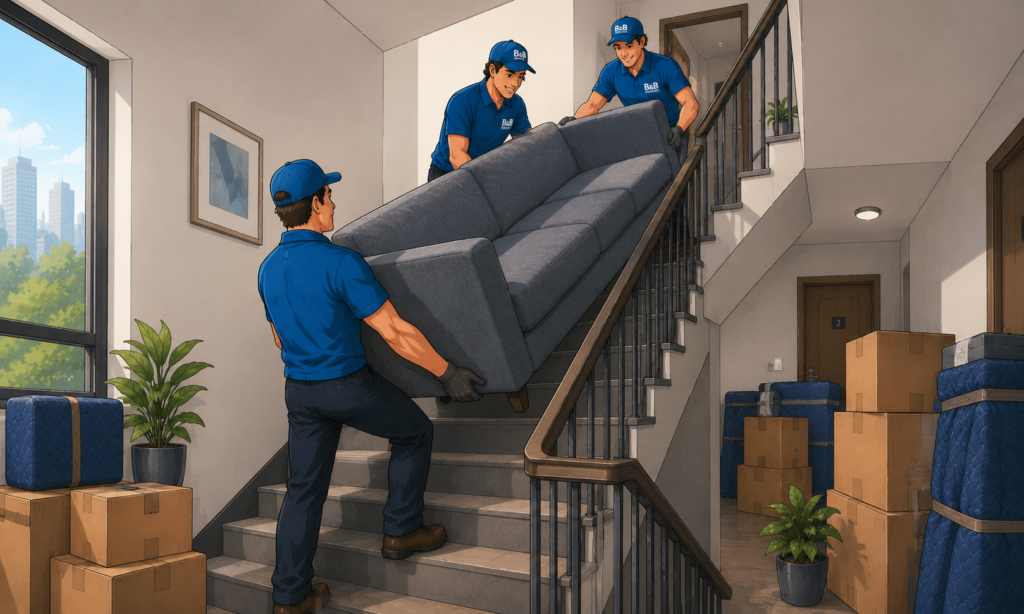
What started as a standard home move quickly turned into solving a problem we didn’t create. The client’s custom L-shaped sofa had been delivered and left on the street by the furniture retailer after they realised it wouldn’t fit inside the building lift. While our original brief was simply to complete the house move, our team stepped into carefully maneuver the oversized furniture through the Zetland apartment stairwell and safely into the home all without charging extra for the inconvenience caused by someone else’s mistake.
A young couple had moved into a two-bedroom apartment on the seventh floor of a modern building in Zetland. They booked us to handle the full relocation furniture, boxes, appliances from their previous rental in Newtown. Standard residential move so building access booked in advance.
Two days before the move, the client called. Their new custom sofa, a L-shaped piece ordered from a designer furniture retailer had arrived for delivery that morning. The retailer’s delivery team had taken one look at the service lift and refused. The oversized sofa was far wider than the lift. They left it on the pavement outside the building and issued a refund on the delivery fee. The oversized sofa was now sitting on a public footpath in Zetland. The client needed it upstairs before their move-in date, and they didn’t know how.
The challenges of the oversized furniture
The lift was too small, and it wasn’t going to change. The building’s service lift measured 950mm wide by 1,200mm deep. The sofa’s L-section measured 2,400mm at its widest. No angle, no tilt, no combination of the two was going to change those numbers. The internal route was definitively closed.
The sofa was not modular. Our first hope was that the L-shape was two separate sections that connected. It wasn’t. This was a single-frame bespoke piece solid timber frame, fully upholstered, no separation point. Disassembly was not an option without destroying a piece of furniture that had cost the client over $6,000.
The stairwell was unusable. We checked the fire stairwell as an alternative. Seven floors, 90-degree turn at every landing, stairwell width of approximately 1,000mm. A 2,400mm L-shaped sofa cannot navigate a 90-degree landing under any carry technique. That route was also closed.
The oversized sofa was on a public footpath. This wasn’t furniture sitting safely inside a lobby or storage room. It was on the street, wrapped in the retailer’s transit plastic, exposed to weather and foot traffic. Every hour it stayed there was a risk to a $6,000 piece of furniture and a source of serious stress for the client.
The building’s body corporate rules required prior approval for any external lift operation. We couldn’t simply bring in a hoist and start lifting from the street. Approval had to be obtained, the building manager had to be notified, and the operation had to comply with the building’s OH&S requirements. All of this had to happen within 48 hours.
How we solved it
We contacted the building manager the same afternoon. Before we committed to any solution, we called the building manager directly to explain the situation and request approval for an external lift operation. We outlined the equipment, the safety process, the timing, and the insurance cover. Approval was granted the following morning.
We arranged a furniture hoist truck for the day before the main move. Rather than combining the sofa operation with the full move, we scheduled it separately this kept the main moving day clean and manageable, and ensured the oversized sofa was safely inside the Zetland apartment before boxes and other furniture began arriving.
We stored the sofa overnight at no charge to the client. The sofa couldn’t stay on the footpath. We brought it back to our depot on the afternoon of the call and stored it overnight in our secure facility. This was not something the client asked for it was the only sensible option and we did it without adding to the bill.
The hoist operation. The following morning, our team wrapped the sofa in four layers of furniture blankets and a full layer of stretch wrap protecting every corner and surface of the upholstery. The hoist truck was positioned in the building’s driveway, which had sufficient clearance, and the platform was extended to the seventh-floor balcony level. The oversized sofa was rigged at two load-bearing points, raised on the exterior of the building, and guided over the balcony railing by two crew members positioned above. The entire lift took 38 minutes from the moment the truck parked to the moment the sofa was inside the apartment, positioned in the living room, and unwrapped.
We carried out the main move the following day as scheduled. The client’s move-in proceeded exactly as originally planned. The sofa problem had been resolved cleanly in advance, the Zetland apartment was ready to receive the rest of the furniture, and the main moving day ran without a single access issue.
What the experience felt like from the inside
What stood out on this job wasn’t the technical difficulty the hoist operation itself was well within what our team does regularly. What stood out was the compounding nature of the problem: a third party’s failure, a time-sensitive situation, a high-value item at risk, and a client who had done everything right on their end and was now dealing with consequences they hadn’t caused.
The crew’s focus on the hoist morning was not on getting it done quickly. It was on getting it done without a scratch. A $6,000 bespoke sofa that has spent a night in secure storage and then been lifted seven floors by an external hoist needs to arrive in the living room looking exactly as it did in the showroom. The wrapping process alone took 20 minutes. That is not inefficiency that is the job being done correctly.
There was also a quiet satisfaction in the team about the fact that this problem existed before we arrived and wouldn’t exist after we left. The furniture retailer had walked away from it. We didn’t.
What the client said
“I genuinely didn’t know what to do when the delivery company just left the sofa on the street. I called B&B Removals in a panic and within an hour they had a plan. They picked the sofa up the same day, stored it overnight, and had it in our Zetland apartment the next morning before we’d even had coffee. The main move the day after was completely stress-free. I’ve never dealt with a removalist that just quietly fixed things without making a fuss about it.”
The client also followed up after the move to let us know they had contacted the furniture retailer to report what had happened and mentioned B&B Removals by name as the company that resolved a problem the retailer had created and abandoned. We received a referral from that retailer three weeks later.
Conclusion
The oversized furniture problem wasn’t ours in this case. The furniture retailer had delivered an item without verifying it would fit through the building’s access points a basic failure of due diligence that left their client without a sofa and without a solution.
We didn’t take it on because it was our responsibility. We took it on because the client needed it solved, because we had the expertise and the equipment to solve it, and because walking away from a problem that we could fix is not how we operate.
Every residential move in Sydney carries the possibility of an access problem a lift that’s too small, a stairwell that won’t turn, a corridor that’s 30mm too narrow. The difference between a good removalist and a great one is not whether problems occur. It’s what happens in the moment when they do.
If you are planning a residential move in Sydney and you have large or oversized furniture, talk to us before moving day. We assess access, identify the risks, and have every solution disassembly, angle carry, balcony hoist, or external lift ready before we arrive.
Key Takeaways from This Oversized Furniture Move
- Oversized furniture should always be measured against lifts, stairwells, and access points before delivery day.
- Not all large sofas are modular — bespoke single-frame furniture often requires specialised moving solutions.
- Professional removalists can organise external hoists, balcony lifts, and access approvals when standard entry routes fail.
- Secure storage and protective wrapping are critical when high-value furniture is left exposed or delayed during a move.
- A great removalist doesn’t just transport furniture — they solve unexpected problems calmly, safely, and without adding stress to the client.
Recent Posts
- Moving House on Settlement Day in Sydney: What Should You Plan For?
- Why Are Removalist Quotes in Sydney So Different?
- 15 Packing Mistakes That Damage Furniture During a Move
- How Much Does It Cost to Hire Removalists in Sydney? A Simple Guide to Understanding Moving Costs
- 12 Signs a Move Is Going to Be Easy Before We Lift the First Box